Acrostic Crossword Puzzles
Egghead Games LLCWord
4.3169.00 Reviews
- Version
- 5.2.4
- Installs
- 10.00K
- Age Rating
- Everyone
Screenshots
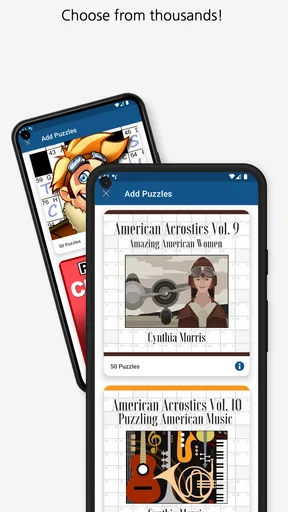
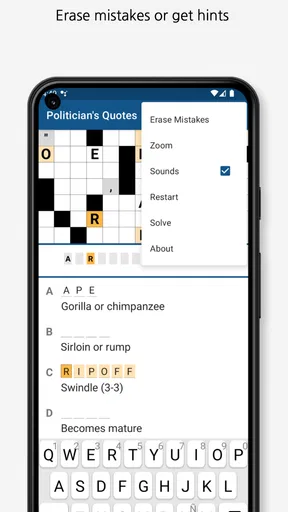
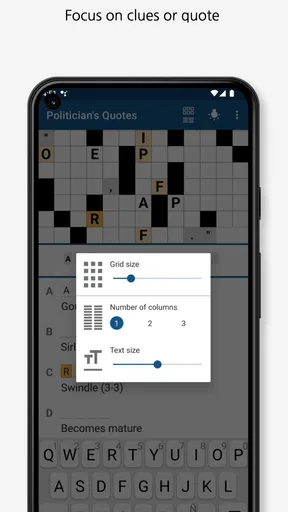
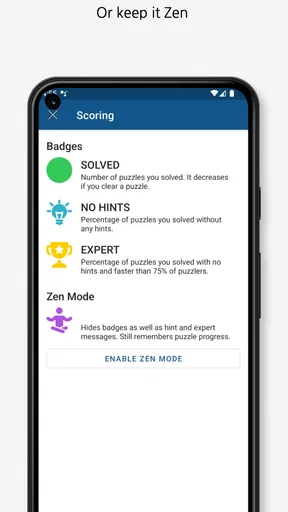
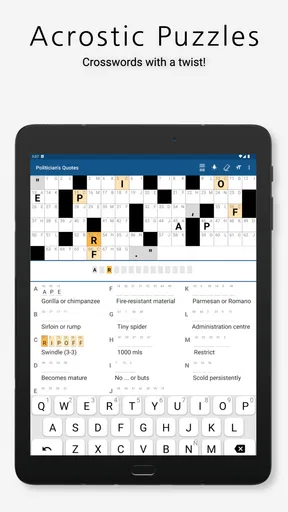
Our Review of Acrostic Crossword Puzzles
 Analysis by Appyee
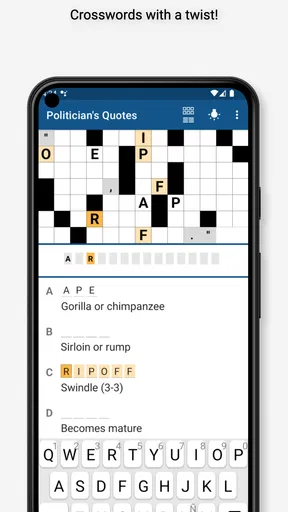
I approached Acrostic Crossword Puzzles expecting a familiar word game, but its appeal became clearer after a few rounds. It combines clue solving with the gradual uncovering of a quotation, so each puzzle gives me two reasons to keep working: I want to answer the individual entries, and I want to see the larger message emerge. That structure makes it more thoughtful than a straightforward crossword while remaining easier to pick up than many dense cryptogram games.
Developed by Egghead Games LLC, this is a paid word game for Everyone. It costs $4.99, with optional in-app purchases ranging from $3.99 to $8.99 per item. The current release is version 5.2.4, and it runs on Android 6.0 or later. Those details matter because this is not positioned as a disposable, free-to-start distraction: it asks for an upfront commitment, then offers additional purchases for players who want them.
How the puzzle loop builds momentum
I find the appeal here less about racing through clues and more about watching scattered answers start to make sense together. In a shared room, that makes it easy for someone nearby to suggest a possibility without taking over the whole puzzle; I can test the idea against the clue and the letters already in place. That casual back-and-forth is a useful way to approach the game, though it also makes personal play boundaries worth thinking about.
The first goal is simple, but the quotation gives it direction
The opening objective is easy to understand. I solve crossword-style clues, use those answers to work through the puzzle, and gradually reveal a hidden quotation. That final reveal gives otherwise separate answers a shared purpose. Instead of treating each clue as an isolated test, I can use the emerging quotation as a source of context and motivation.
This is particularly useful when I am solving in short sessions. If I have only a few minutes, I can tackle one or two clues without needing to remember a complicated ruleset. If I have more time, the partially revealed quotation gives me a natural reason to continue. The game does not need an elaborate mission structure to create a goal; the puzzle itself supplies one.
What I like most is the way the hidden text changes my attitude toward uncertainty. In an ordinary crossword, an answer can remain doubtful until crossing letters settle it. Here, the quotation can become another layer of evidence. A word that seems plausible may look wrong once the larger sentence begins to take shape, while a difficult clue can become more approachable when the surrounding message suggests its role.
That also means the game rewards patience rather than random guessing. I found it more satisfying to leave a stubborn entry alone, solve several easier clues, and return once the quotation had offered more guidance. The best moments come from those small reversals, when an answer that felt obscure suddenly becomes obvious because the puzzle has supplied enough context.
Progress is visible without turning the game into a checklist
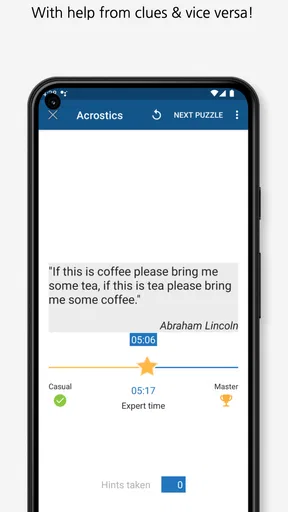
The strongest progress signal is the quotation itself. Every solved clue contributes to a broader picture, so advancement is visible directly on the puzzle rather than hidden behind a separate collection screen or a stream of rewards. I always know whether I am merely filling letters or genuinely moving toward completion.
That design creates a useful rhythm. Early progress feels quick because even a few answers begin to expose the quote. The middle portion asks for more concentration, since the remaining clues are less likely to be solved through immediate recognition. Near the end, each answer feels important because it closes another gap in the message.
I also appreciate that the quotation acts as a memory aid. When I pause and return later, I do not have to reconstruct the entire state of play from scratch. The visible phrase reminds me what I was working toward and can help me recover the reasoning behind uncertain entries. This makes the game better suited to interrupted play than a puzzle that depends entirely on maintaining a mental chain from one move to the next.
There is a trade-off, however. Players who prefer a constant stream of obvious rewards may find the progression understated. The satisfaction comes from solving and revealing, not from a heavily signposted campaign. If you need badges, character upgrades, or a dramatic sense of unlocking new content, this quieter structure may feel too restrained.
The difficulty curve depends on how you use partial information
The challenge is not only about knowing vocabulary. It is also about deciding when to trust a clue, when to wait for crossing information, and when to let the quotation guide the answer. That makes the difficulty curve feel flexible. A player with strong word knowledge may move quickly through clues, while someone less confident can still make progress by combining partial answers with the emerging quote.
In my experience, the hardest moments are not necessarily the longest words. Short answers can be surprisingly troublesome because they allow several possibilities, and a small mistake can affect the way the quotation appears. I learned to avoid forcing an answer simply because it fit the clue in isolation. Checking how it affects the larger phrase is often the more reliable approach.
A practical method is to begin with clues that have a clear definition or an answer you recognize immediately. Then I use those completed entries to narrow the uncertain ones. Once several pieces of the quotation are visible, I scan for familiar phrasing, grammatical patterns, and likely word lengths. This is more efficient than moving through the grid in strict order.
Another useful habit is to treat the quotation as confirmation rather than permission to guess. It can point me toward a likely word, but I still want the clue and the crossing letters to support it. That distinction keeps the game from becoming a simple exercise in completing famous phrases. The wordplay remains central, while the quote functions as a second reasoning channel.
The format should suit players who enjoy language and deduction more than speed. I would not choose it for a timed competitive session or for a game that depends on rapid reactions. Its challenge is measured in attention and interpretation, so the experience works best when I allow myself to think rather than rush.
What keeps me playing, and where the pressure fades
The main retention pressure comes from unfinished information. Once part of a quotation is visible, an incomplete phrase can be more tempting than a progress bar. I often want to finish because the missing words feel close enough to identify, even when the clues themselves are resisting me.
That pressure is gentle rather than aggressive. The game encourages continuation through curiosity and puzzle structure, not through a frantic countdown. For me, that makes it comfortable during a commute, a quiet break, or an evening when I want something mentally active without the intensity of an action game.
The paid model also changes how I view the experience. Paying $4.99 at the start sets a clear expectation that the core value should come from the puzzles themselves. I am less tolerant of friction when I have already paid to enter, and I would recommend checking the purchase arrangement carefully if optional items are important to you. The additional items are priced between $3.99 and $8.99 each, so players who prefer a strictly one-time-cost experience should consider that before spending more.
For me, the upfront price is easiest to justify when I expect to return to word puzzles regularly. Someone who only wants an occasional free diversion may find the commitment harder to defend, especially when many crossword and word-game alternatives use free entry. On the other hand, players who dislike ad-heavy casual games may appreciate beginning with a paid product rather than navigating a purely free-to-play loop.
The rating provides some useful context: the game holds a 4.3 average from around 467 ratings, with roughly 169 written reviews. It has also passed 10,000 installs. I would not treat those figures as a substitute for personal taste, but they suggest a focused audience rather than a huge mainstream game. That matches my impression: this is a specialized word-puzzle experience, not a broad social platform trying to appeal to everyone.
A realistic way to fit it into daily life
I can imagine using it after lunch when I want a break that feels more purposeful than scrolling. I might solve the obvious clues first, stop when a meeting or task interrupts me, and return later with the partially revealed quotation still acting as a reminder. Because the central objective is self-contained, I do not need to coordinate with other players or maintain a daily streak to make the session worthwhile.
It also works well as a quieter evening activity. I can spend longer on one puzzle and compare different possibilities instead of chasing a high score. That makes it a good choice for someone who likes books, language trivia, or traditional paper puzzles but wants the convenience of solving on a phone or tablet.
I would be more cautious about recommending it to a person who wants endless novelty with minimal repetition. The core pleasure comes from the same relationship between clues, letters, and a hidden quotation. If that loop does not appeal to you after the first few puzzles, the paid entry may not feel worthwhile. Likewise, players looking for multiplayer competition, fast rounds, or a strong narrative should choose a different type of game.
How it compares with ordinary crossword and cryptogram apps
Compared with a standard crossword app, this game gives the completed grid an extra destination. A normal crossword can be satisfying because of its crossings and clue variety, but the answers do not necessarily form a single final idea. Here, the quotation gives me a reason to care about the relationship between entries beyond simply filling spaces.
Compared with a traditional cryptogram, it is more approachable because the clues provide an independent route into the answer. A pure cryptogram can ask me to infer a substitution pattern from letter frequency and repeated words. This format still has a code-breaking flavor, but I am not relying only on numerical or linguistic pattern analysis. The clue-solving layer gives me something concrete to work on when the hidden message is not yet clear.
That hybrid design is also its main limitation. People who prefer the clean logic of a pure cryptogram may find the crossword component less elegant, while dedicated crossword fans may want broader clue variety or a more familiar grid experience. The game occupies the middle ground successfully, but middle ground is not automatically the best destination for every player.
It is also less suitable than a free daily crossword service for someone who wants a predictable, low-commitment routine. Those alternatives may be better if your priority is variety without an upfront purchase. I would choose this one instead when the hidden quotation is the feature that makes a puzzle feel complete.
Small strategies that make the experience better
My first recommendation is to solve for certainty, not for order. There is no benefit in attacking the first clue that catches your eye if another entry can provide several useful letters. I start with answers whose definitions are clear, then use the resulting structure to revisit ambiguous clues.
Second, I keep an eye on the quotation without allowing it to override the clue. A recognizable phrase can create false confidence, especially when several short words seem possible. I use the message to generate candidates, then verify those candidates against the clue and the surrounding letters. This prevents a single attractive guess from distorting the rest of the puzzle.
Third, I treat a pause as part of the solving process rather than a failure. When I am stuck, stepping away can be more productive than cycling through guesses. Returning with fresh attention often makes a clue readable in a different way, and the partially exposed quotation may have become easier to interpret simply because I am no longer staring at it continuously.
Finally, I would avoid buying optional items until I understand my own solving habits. Since the game already has a $4.99 purchase price and the extra items cost from $3.99 to $8.99, it makes sense to decide whether the basic puzzle loop holds your attention first. That is especially important for casual players who may enjoy the concept more than repeated sessions.
Who should choose it
I recommend it to people who like crosswords but want a stronger sense of completion, and to cryptogram fans who would welcome direct clue support. It is also a good fit for readers who enjoy quotations and prefer thoughtful, pause-friendly games over timed challenges. The Everyone rating makes it broadly accessible, although the real question is whether its language-based reasoning matches your interests.
I would skip it if you want a free-first experience, competitive leaderboards, rapid action, or a large social layer. I would also hesitate to suggest it to someone who dislikes being stuck on a clue, because the game’s satisfaction depends partly on working through uncertainty. A more forgiving word search or a simple anagram game may be a better first choice for relaxed, low-effort play.
My progression verdict
The progression works because every solved clue improves both the puzzle and the message. Early goals are immediately understandable, progress is visible in the quotation, and the difficulty rises through interpretation rather than artificial pressure. The pacing gives me permission to stop and return, while the unfinished phrase keeps the experience from feeling aimless.
Its weaknesses are tied to the same design. The loop is focused, so it may feel narrow beside larger word-game collections. The paid entry requires more confidence than a free download, and optional purchases mean the total cost can grow for players who choose them. There is also no reason to expect this format to satisfy someone seeking speed, competition, or a dramatic unlock system.
Still, I think Egghead Games LLC made a smart choice by connecting every small answer to a larger verbal payoff. The result is a word game that rewards careful solving and makes short sessions feel meaningful. With an average of 4.3 and more than 10,000 installs, it has found a modest but clear audience, and I can understand why. For me, this is best enjoyed as a calm quotation-driven puzzle rather than as an endlessly expanding game.
Verdict
Strengths of Acrostic Crossword Puzzles
- Combines crossword clues with acrostic solving for varied puzzle sessions.
- Helpful hints make difficult entries manageable without revealing the whole answer.
- Clean interface keeps the focus on clues and letter placement.
- Puzzle variety supports both quick play and longer solving sessions.
- Offline access lets you play without a constant internet connection.
Limitations of Acrostic Crossword Puzzles
- Some puzzles may feel repetitive after extended play.
- Hints or extra puzzle content may be limited without in-app purchases.
- Small text can be uncomfortable on phones with compact screens.
- Difficulty can vary noticeably between consecutive puzzles.
- Progress may be frustrating if an answer depends on obscure vocabulary.
Other Releases by Egghead Games LLC
View All
Similar Picks in This Category
View All
Word Search - Word Puzzle Game
Bluetile4.8

Word Search Quest - Puzzles
Blackout Lab4.8

CodyCross: Crossword Puzzles
Fanatee, Inc.4.7

Words of Wonders: Crossword
Fugo Games4.9

Wordscapes: Word puzzle game
PeopleFun4.7

Word Search Explorer
PlaySimple Games4.9
Frequently Asked Questions
What is Acrostic Crossword Puzzles?
Acrostic Crossword Puzzles is a word game that combines crossword-style clues with an acrostic puzzle format. You solve a series of clues and use the answers to reveal a quotation, phrase, or message. The game is designed for players who enjoy vocabulary challenges, logic, and relaxed puzzle sessions rather than fast-paced action.
How does the gameplay work?
Each puzzle presents clues that must be answered with the correct words. Letters from those answers are then placed into a connected grid or message area, gradually uncovering the hidden quotation. You can work through the clues in different orders, use crossing letters to confirm guesses, and correct entries when an answer does not fit the puzzle.
Is Acrostic Crossword Puzzles suitable for beginners?
Yes, the game is generally approachable for beginners, especially for anyone familiar with crosswords, word searches, or anagram games. Early puzzles can help you understand the layout and solving process before the challenge increases. However, some clues may require broad vocabulary, knowledge of quotations, or careful interpretation, so occasional hints may be useful.
Does the game require an internet connection?
The basic puzzle experience may be available offline after the relevant content has loaded, which makes it convenient for travel or playing without mobile data. Nevertheless, certain features can depend on an internet connection, including advertisements, updates, synchronization, or optional purchases. Availability may vary by device and version, so checking the app’s store listing is recommended.
Are there hints, advertisements, or in-app purchases?
Acrostic Crossword Puzzles may include optional assistance tools such as revealing a letter, solving part of a clue, or providing another form of hint when you are stuck. Depending on the version, free gameplay can also be supported by advertisements, while in-app purchases may remove ads or provide extra benefits. Review the pricing details before downloading.
Play our best games!


